
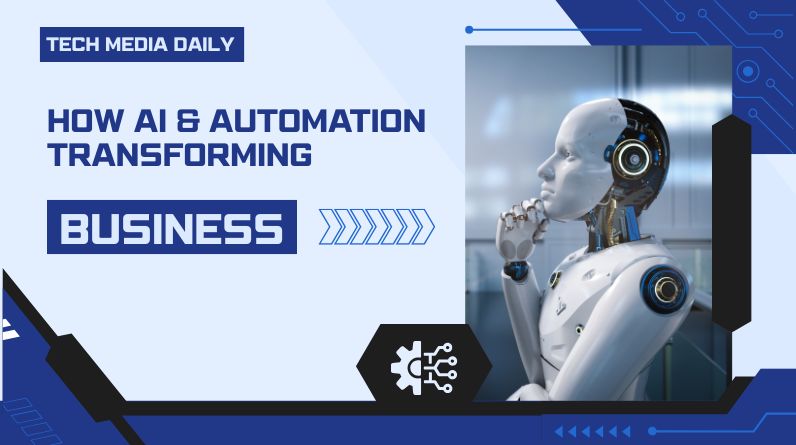
Artificial intelligence (AI) and automation are reshaping the way companies operate, compete, and innovate in today’s market. Far from being just futuristic technologies, AI and automation are already driving deep change in business workflows, customer interactions, and organizational strategy. This transformation spans sectors from finance to logistics, redefining productivity, speed, and decision-making at every level.
What AI and Automation Mean for Businesses
In modern business, AI refers to systems that learn from data, recognize patterns, and make predictions or decisions with minimal human intervention. Automation uses software, robotics, or AI to execute routine tasks without manual effort. When combined — often called intelligent automation — these technologies help companies operate smarter and faster by handling both simple and complex work.
Together, AI and automation:
- Streamline repetitive processes
- Boost operational efficiency
- Support faster, data-driven decisions
- Enable scalability without proportional increases in cost or labor
Key Ways Businesses Are Being Transformed
1. Operational Efficiency and Cost Savings
AI-driven automation significantly reduces time spent on routine tasks. Systems trained on data can complete work such as data entry, document processing, or internal approvals more quickly and with fewer errors than manual methods. This not only cuts operating costs but also frees up employees to tackle strategic priorities that drive growth and innovation.
2. Smarter Decision-Making Through Data
Machine learning models can digest vast amounts of business data and extract patterns humans might miss. This capability empowers leaders to make decisions backed by real-time insights — from inventory forecasting to sales optimization — rather than relying on intuition alone.
3. Enhanced Customer Interactions
Automation improves customer experience through consistent and personalized service. AI chatbots and virtual assistants are now common on company websites and support channels, providing instant answers around the clock. Personalization engines analyze user behavior to recommend products or content tailored to individual preferences — fostering loyalty and higher conversions.
4. Workforce Evolution and Job Roles
Rather than eliminating human work entirely, AI often changes the nature of it. Many businesses are using AI to take over repetitive or low-value tasks so employees can focus on creative, analytical, or relationship-oriented work. Some U.S. companies report increased productivity as a result of automation while encouraging employees to upskill and adapt to roles that require judgment and strategic thinking.
5. Industry-Specific Examples
Across sectors, AI and automation show tangible impact:
- Finance: Banks use AI for fraud detection and credit risk analysis, improving accuracy and speed in essential operations.
- Healthcare: AI systems sift through millions of administrative records to automate billing and documentation, saving thousands of employee hours each month.
- Retail and Logistics: Inventory management and delivery routing algorithms help companies optimize stock levels and reduce shipping times.
Beyond Efficiency: What Many Leaders Overlook
While most articles highlight speed and cost savings, a deeper reality is that AI and automation also affect how work gets organized and how companies think about risk, ethics, and human value.
AI Changes Productivity Metrics
Traditional measures of productivity focus on output per hour or cost reduction. But AI and robotics shift focus toward adaptability, resilience, and system intelligence. In practice, companies start valuing how technologies handle variability, unexpected conditions, and complex environments — not just how fast they execute simple tasks.
Workforce Transition and Skills Gaps
Not all workers benefit equally from automation. Surveys show that AI adoption is higher in tech-intensive roles and less common in service-oriented jobs. As a result, some segments of the workforce may struggle with job transitions or upskilling without targeted support. Forward-thinking companies are investing in training programs to help employees move into roles that leverage human strengths like creativity, empathy, and judgment.
Strategic Integration Matters
Simply adding AI tools doesn’t guarantee success. Leaders emphasize that companies must rethink internal processes and policies to make the most of AI — not just layer tools onto outdated frameworks. Successful transformation often involves redesigning workflows with AI in mind, not around existing habits.
Conclusion
AI and automation are no longer optional add-ons; they are central to business competitiveness and resilience. From boosting operational efficiency and shaping customer experiences to redefining job roles and strategic planning, these technologies are transforming how organizations function. At the same time, they bring challenges around workforce readiness and ethical use that require thoughtful leadership. Companies that navigate this landscape with a balanced approach are best positioned to thrive in the evolving business environment.